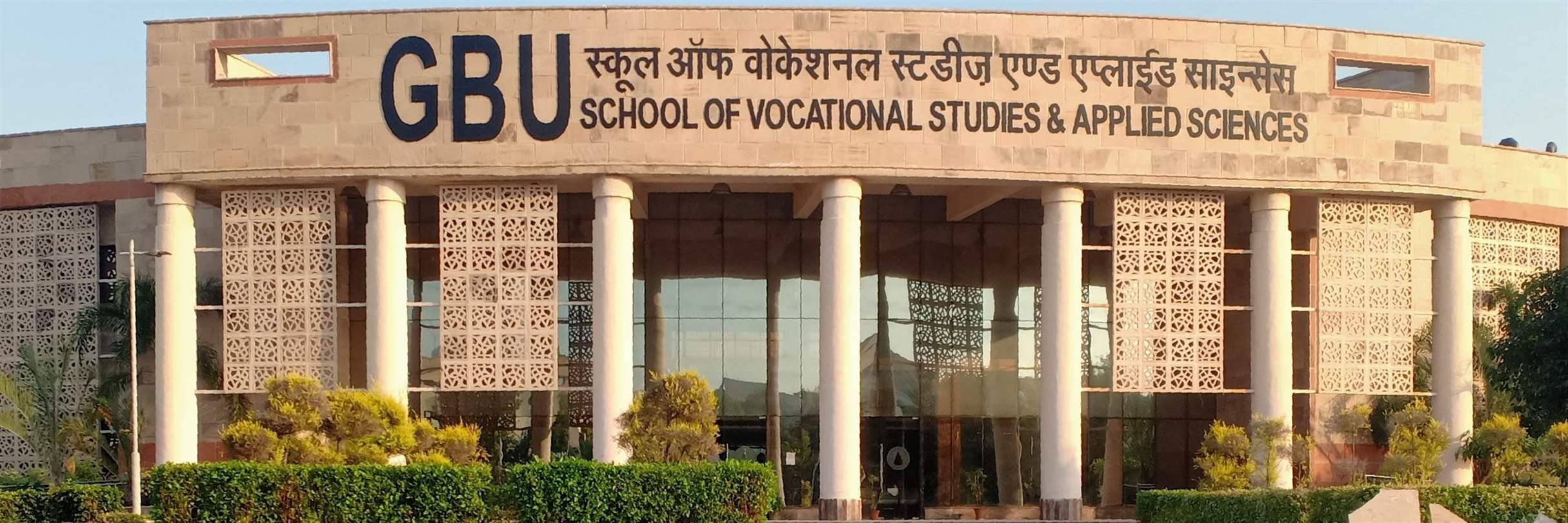


School of Vocational Studies and Applied Sciences
The University School of Vocational Studies and Applied Sciences (USoVSAS) comprises of primary disciplines of Physics, Chemistry and Mathematics along with two interdisciplinary subjects, viz., Environmental Science, and Food Processing and Technology. All academic programmes of the School lay emphasis on the integration of the existing theoretical knowledge with practical applications. Through its academic and research staff, the School possesses a huge depth and breadth of scientific and technological knowledge. The School offers core courses in Physical, Chemical and Mathematical Sciences to undergraduate students of all branches of Science, Engineering, Biotechnology and Information & Communication Technology. The Course "Environmental Studies" is offered to all Undergraduate students of all streams of education in the University as "Ability Enhancement Compulsory Course". The School has been successfully conducting postgraduate and doctoral programmes in Physics, Chemistry, Mathematics, Food Processing & Technology, Food Science, and Environmental Science since 2011-12.
TThe USoVSAS started its undergraduate programme B.Sc.(Hons) in Physics, Chemistry and Mathematics from academic session 2019-20, B.Sc. in Mathematics, Statistics, and Economics from the academic session 2023-24, B.Sc. (Hons.) in Environmental Science from the academic session 2024-25, and P.G. Diploma programme from the academic session 2022-23. These programmes of the School support specialized interdisciplinary fields of teaching, research and industry engagement in polymer chemistry, green chemistry, pharmaceutical chemistry, environmental science, food technology, food science, photonics & optoelectronics, semiconductor optoelectronics devices, plasmonics, thin films, nanotechnology, computational fluid dynamics, operations research, functional differential equations, cryptography, number theory, and mathematical problems in extreme weather events. The School has been very active in conducting workshops, organizing national and international conferences and seminars, and has well-acknowledged faculty research profile. Some of the faculty members have been the "winners of excellence award in research and Fellow of professional societies". The research activities in the School have been supported by the government agencies, such as, DST, CSIR and UPCST.
The USoVSAS is promoting actively the Academia-Institutions-Industry linkages through Memorandum of Understanding (MoUs) with leading national and international Universities, R&D Institutions, and industries. The "Scientific Social Responsibility" is achieved by organizings field visits to slums and urban-rural areas, and activities during celebration of the Earth Day, World Environment Day, World Food Day, National Science Day, National Mathematics Day, and National Chemistry Day.
Laboratories
Apart from the basic laboratories for undergraduate Engineering and Science students, the School has advanced practical and computational laboratories in various disciplines for postgraduate/doctoral students. These are: Physics Labs, Chemistry Labs, Mathematics Computer Labs, Environmental Science Labs, and Food Processing & Technology Labs.
Teaching-Learning Plans "Even Semester, 2023-24"
B.Tech. Food Processing and Technology
M.Tech. Food Processing and Technoloy
MoU signed by School of Vocational Studies and Appled Sciences
Diploma in School of Vocational Studies and Appled Sciences
PG Diploma in Polyurethane Technology
Overview
The University School of Vocational Studies and Applied Sciences (USoVSAS) comprises of primary disciplines of Physics, Chemistry and Mathematics along with two interdisciplinary subjects, viz., Environmental Science, and Food Processing and Technology. All academic programmes of the School lay emphasis on the integration of the existing theoretical knowledge with practical applications. Through its academic and research staff, the School possesses a huge depth and breadth of scientific and technological knowledge. The School offers core courses in Physical, Chemical and Mathematical Sciences to undergraduate students of all branches of Science, Engineering, Biotechnology and Information & Communication Technology. The Course "Environmental Studies" is offered to all Undergraduate students of all streams of education in the University as "Ability Enhancement Compulsory Course". The School has been successfully conducting postgraduate and doctoral programmes in Physics, Chemistry, Mathematics, Food Processing & Technology, Food Science, and Environmental Science since 2011-12.
TThe USoVSAS started its undergraduate programme B.Sc.(Hons) in Physics, Chemistry and Mathematics from academic session 2019-20, B.Sc. in Mathematics, Statistics, and Economics from the academic session 2023-24, B.Sc. (Hons.) in Environmental Science from the academic session 2024-25, and P.G. Diploma programme from the academic session 2022-23. These programmes of the School support specialized interdisciplinary fields of teaching, research and industry engagement in polymer chemistry, green chemistry, pharmaceutical chemistry, environmental science, food technology, food science, photonics & optoelectronics, semiconductor optoelectronics devices, plasmonics, thin films, nanotechnology, computational fluid dynamics, operations research, functional differential equations, cryptography, number theory, and mathematical problems in extreme weather events. The School has been very active in conducting workshops, organizing national and international conferences and seminars, and has well-acknowledged faculty research profile. Some of the faculty members have been the "winners of excellence award in research and Fellow of professional societies". The research activities in the School have been supported by the government agencies, such as, DST, CSIR and UPCST.
The USoVSAS is promoting actively the Academia-Institutions-Industry linkages through Memorandum of Understanding (MoUs) with leading national and international Universities, R&D Institutions, and industries. The "Scientific Social Responsibility" is achieved by organizings field visits to slums and urban-rural areas, and activities during celebration of the Earth Day, World Environment Day, World Food Day, National Science Day, National Mathematics Day, and National Chemistry Day.
Laboratories
Apart from the basic laboratories for undergraduate Engineering and Science students, the School has advanced practical and computational laboratories in various disciplines for postgraduate/doctoral students. These are: Physics Labs, Chemistry Labs, Mathematics Computer Labs, Environmental Science Labs, and Food Processing & Technology Labs.

Dean's Message
I have great pleasure in welcoming you to the School of Vocational Studies and Applied Sciences (SoVSAS), established in the year 2010 at the Gautam Buddha University. Basic and Applied Sciences are the essence of Engineering and Technology. The School is offering diverse undergraduate, post graduate and P.G. Diploma courses, and doctoral research programmes through its five Departments, viz., Applied Physics, Applied Chemistry, Applied Mathematics, Environmental Science, and Food Processing and Technology.
We are committed to provide quality education to the students of diverse background and experience on the subjects to meet the need - based national and global demand of skillful human resource. This website offers you the information you need to make your decisions about the right programme timely for your study. I hope that your experience with us will not only see you to achieve your dynamic career but also serve to stretch your imagination.
The faculty members at the SoVSAS, Gautam Buddha University eagerly look forward for the opportunity to work with bright, inquisitive and ignited minds - the students, and to collaborate with colleagues at the head of their profession.
We welcome your participation, and express our commitments to support you to create globally - competitive opportunities for successive generations of the students and the faculty.
Prof. Chander Kumar Singh
Dean, School of Vocational Studies & Applied Sciences
Board of Studies
Prof. Chander Kumar Singh
Dean
Professor
School of Vocational Studies & Applied Sciences
Gautam Buddha University
External Members
Prof. R.C. Sharma
(Formerly Professor, Department of Applied Chemistry and Polymer Technology
Delhi Technological University, New Delhi 110 042)
Residence:
C- 24 Greenview Apartments
Plot No 33, Sector 9, Rohini, New Delhi 110 085.
Prof. Shruti Agarwal
Dean, School of Basic and Applied Sciences
Guru Govind Singh Indraprastha University
Dwarka, New Delhi 110 037.
Prof. Neo Kant Dev
Formerly Professor, Department of Mathematics
Delhi Technological University, New Delhi 110 042.
Prof. Rajeev Kumar Srivastava
Head, Department of Environmental Science
College of Basic Sciences and Humanities
Govind Ballabh Pant University of Agriculture and Technology
Pantnagar 263 145 Distt. U.S. Nagar (Uttarakhand)
Prof. Ashutosh Upadhyay
National Institute of Food Technology,
Entrepreneurship and Management (NIFTEM)
Sonipat 131 028 (Haryana)
Departments | SOVSAS
The School of Vocational Studies and Applied Sciences has following departments:
- Department of Applied Mathematics
- Department of Applied Chemistry
- Department of Applied Physics
- Department of Environmental Sciences
- Department of Vocational Studies
- Department of Food Processing and Technology
Department of Applied Chemistry | SOVSAS
Department of Food Processing and Technology | SOVSAS
About the Department
“From Farm to Fork: Innovating Food for a Safer and Sustainable Tomorrow.”
The Department of Food Processing and Technology at Gautam Buddha University was established under the School of Vocational Studies and Applied Sciences (SoVSAS) with the objective of advancing education, research and innovation in food science, food processing, and value addition to agricultural products. Since its establishment, the department has consistently focused on preparing competent professionals and researchers who can address emerging issues related to food quality, safety, nutrition, and sustainability. The department is strengthened by a team of qualified and committed faculty members specializing in various domains of food technology.
The department is equipped with modern laboratories and advanced processing facilities that provide an enabling environment for academic learning, research activities, product development, and industry-focused training. The available infrastructure supports hands-on experience, analytical evaluation, and innovative work across multiple areas of food technology.
A variety of academic programmes are offered to provide students with a strong blend of theoretical understanding and practical expertise. These include B.Tech. in Food Technology, M.Tech. in Food Technology, M.Sc. in Food Science and Technology, and Ph.D. in Food Technology. The B.Tech. programme lays the groundwork in food processing, engineering concepts, and food safety, while the M.Sc. and M.Tech. programmes focus on advanced studies, research, and technological applications. The Ph.D. programme is designed to develop research scholars capable of contributing to academia, research institutions, and the food industry.
Beyond academics, the department conducts seminars, workshops, industrial visits, and training sessions to enhance students’ skills and professional development. Students are actively encouraged to engage in research projects, internships, and collaborations with industry and research organizations, providing them with valuable practical exposure.
With its interdisciplinary outlook, robust academic structure and emphasis on innovation and sustainability, the department continues to grow as a vibrant hub for education, research and technological progress in the field of food processing.
HoD’s Message
The Department of Food Processing and Technology is dedicated to delivering high-quality education and practical expertise in food technology. The department offers undergraduate, postgraduate, and doctoral programmes. Our goal is to equip students with a comprehensive understanding of various aspects of food technology, transforming them into world-class scientists and entrepreneurs who can make meaningful contributions to the food industry, scientific community and society. The department emphasises both theoretical knowledge and practical training through laboratory work, projects and industry exposure. Our faculty members are committed to supporting students’ academic growth and career development.
I wish success to our students in their studies and future careers and invite our future students to join the department for a successful and impactful career in the field of food technology.
Dr. Nitin Sonkar
Head of Department
Programmes Offered
- The Department of Food Technology offers a comprehensive academic pathway with B.Tech., M.Tech., M.Sc., and Ph.D. programmes, fostering excellence in education, innovation, and research.
- With well-structured curricula and optimal student intake, the programmes ensure personalised learning, advanced practical exposure, and strong industry readiness.
- The department is committed to cutting-edge research, skill development, and industry collaboration, preparing students to excel in the dynamic global food sector.
| Programme | Seats | Duration |
|---|---|---|
| B.Tech. (Food Processing and Technology) | 30 | 4 Years (8 Semesters) |
| M.Tech. (Food Processing and Technology) | 15 | 2 Years (4 Semesters) |
| M.Sc. (Food Science & Technology) | 20 | 2 Years (4 Semesters) |
| Ph.D. (Food Processing and Technology) | As per the UGC/University norms | -- |
Activities & Events
The department organizes seminars, workshops, industrial visits, and training programs to enhance
student skills and industry exposure.
Departmental Activities/Events
Infrastructure & Labs
The department houses advanced laboratories and processing facilities supporting academic learning,
product development, and research activities.
Department Infrastructure
Image Gallery
Let’s Connect
Scan a QR code or click the button to visit us on social media.

Programme | SOVSAS
| S.No. | Department | Program Name | Course Structure/Syllabus |
|---|---|---|---|
| 1. | AM | B.Tech. (Maths and Computing) | Course Structure |
| 2. | FPT | B.Tech. (Food Processing and Technology) | Course Structure |
| 4. | PS | B.Sc. Physical Sciences | Course Structure and Syllabus |
| 5. | PS | B.Sc. Hons Physics/ B.Sc. Hons Physics with research | Course Structure and Syllabus |
| 6. | PS | B.Sc (Hons.) Mathematics | Course Structure |
| 7. | PS | B.Sc (Hons.) in Mathematics, Statistics, Economics | Course Structure |
| 8. | PS | B.Sc (Hons.) in Chemistry | Course Structure |
| 9. | FPT | M.Tech. (Food Processing and Technology) | Course Structure |
| 10. | AC | M.Sc. Chemistry | Syllabus |
| 11. | AP | M.Sc. Physics (with specializations)
Astro Physics Engery Studies Photonics Quantum |
Course Structure Course Structure Course Structure Course Structure |
| 12. | AM | M.Sc. Physics (Batch 2024-26) | Course Structure and Syllabus |
| 13. | AM | M.Sc. Mathematics (Since 2018) | Course Structure |
| 14. | ES | M.Sc. Environmental Science | Course Structure Syllabus |
| 15. | FPT | M.Sc. Food Science | Course Structure |
| 16. | FPT | M.Sc. Geology | Course Structure |
| 17. | AP | Ph.D. (Physics) | Course Structure and Sllabus |
| 18. | AC | Ph.D. (Chemistry) | Course Structure |
| 19. | AM | Ph.D. (Mathematics) | Course Structure |
| 20. | FPT | Ph.D. in Food Processing and Technology | Course Structure |
| 21. | FPT | Ph.D. in Enviornmental Sciences | Course Structure Syllabus |
| 22. | FPT | Post Graduate Diploma in Polyurethane Technology | Course Structure |
Laboratories | SOVSAS
Chemistry Laboratory
1. Undergraduate Laboratory
2. Post-graduation laboratory I
3. Post-graduation laboratory II
4. Advanced Chemistry Laboratory
Physics Laboratory
5. Applied Physics Laboratory I
6. Applied Physics Laboratory II
7. Applied Physics Laboratory III
Mathematics Laboratory
8. Mathematics Laboratory I
9. Mathematics Laboratory II
Food Science Laboratory
10. Food Processing and Technology Laboratory
11. Advanced Food Analysis Laboratory
12. Cereals Pulses and Oilseeds Laboratory
13. Food Microbiology Laboratory
14. Dairy Technology Laboratory
Environmental Science Laboratory
15. Environmental Laboratory I
16. Environmental Laboratory II
Applied Chemistry Laboratory
1. Post Graduate Laboratory I
2. Post Graduate Laboratory II
3. Post Graduate Laboratory III
4. Under Graduate Laboratory I
5. Under Graduate Laboratory II
Applied Physics Laboratory
1. Post Graduate Laboratory I
2. Post Graduate Laboratory II
3. Post Graduate Laboratory III
4. Under Graduate Laboratory I
5. Under Graduate Laboratory II
6. Under Graduate Laboratory III
Academic Collaboration | SOVSAS
Academic collaborations:
- MOU is signed with Department of Food Processing and Technology, Maharana Pratap University of Agriculture and Technology for five years in January 2017.
Patents:
- POLYSACCHARIDE AGENTS AND METHODS FOR REMOVING SOLIDS FROM WATER, US Patent Application No. 61/909,864, filed on November 27, 2013
Collaborators:
- Prof. James H Clark, Green Chemistry Centre of Excellence, University of York UK.
- Department of Chemistry, Texas A & M University, USA.
- Department of Phytochemistry, NBRI, India.
- Department of Chemistry, Texas A & M University, USA.
- Institute of Pesticide Formulation Technology, Ministry of Chemical and Fertilizer, Gurgaon, India.
Guest Speak | SOVSAS
1. As a member of seminar organizing committee organized the following talks:
a. "Anecdotes about Great Scientists (Novel Laureates)" By Dr. D.S. Dhar, Retd. Professor IIT Kanpur ,Feb. 2, 2016
Indian Scientists Memorial Lecture Series 2016-17
22nd August 2016
(a) C.V. Raman Memorial Lecture entitled, "YEAR OF LIGHT AND FIBER OPTICS" by Professor Ajoy Ghatak (former Professor & Head, Deptt. of Physics, IITD
(b)Salim Ali Memorial Lecture entitled, "BUILD THE LAST FIRST" by Professor N.P. Melkania Deptt. of Environmental Science, GBU.
10th April 2017
(a.) P.C.Ray memorial Lecture entitled ""Inception of sustainable Approaches/Green Chemistry: Application in the Synthesis of Biologically Important Scaffolds"by Professor Akhilesh Kumar Verma (D.U.)
(b.)Full day workshop on "Intellectual Property Rights and Scientific Research"
2. Dr. Sanjay Sengupta, NISCAIR, NISCAIR activities, writing scientific papers and science communications on 18.10.14.
3. Delivered a talk on "Material for Defense Applications" by Dr. T. C. Shami, Scientist-F, DRDO and Additional Director, DMSRD Kanpur on 6th February, 2014.
4. National Science Day celebration on 28th February, 2014 was organized by School of Vocational Studies and Applied Sciences. Various Programs were organized including lectures by Eminent Scientists Prof. D. S. Rawat, Department of Chemistry, Delhi University, and Dr. Shubhendu Ghosh, Scientist-G from the Inter University Accelerator Centre, New Delhi, debate and quiz competitions involving students of School of Biotechnology and School of Engineering and School of Vocational Studies and Applied Sciences. The basic objective of National Science Day was to spread the message of importance of science and applications among the people.
5. School of Vocational Studies and Applied Sciences Guest Speakers 2010,2011,2012
Placements | SOVSAS
The corporate relationship center (CRC) involves students strategically and guides them for obtaining appropriate placement. The departmental placement committee which comprises of student representatives supervised by faculty coordinators works in collaboration with the university CRC.
 Placement Record of Students of SoVSAS (First Batch 2012-2014)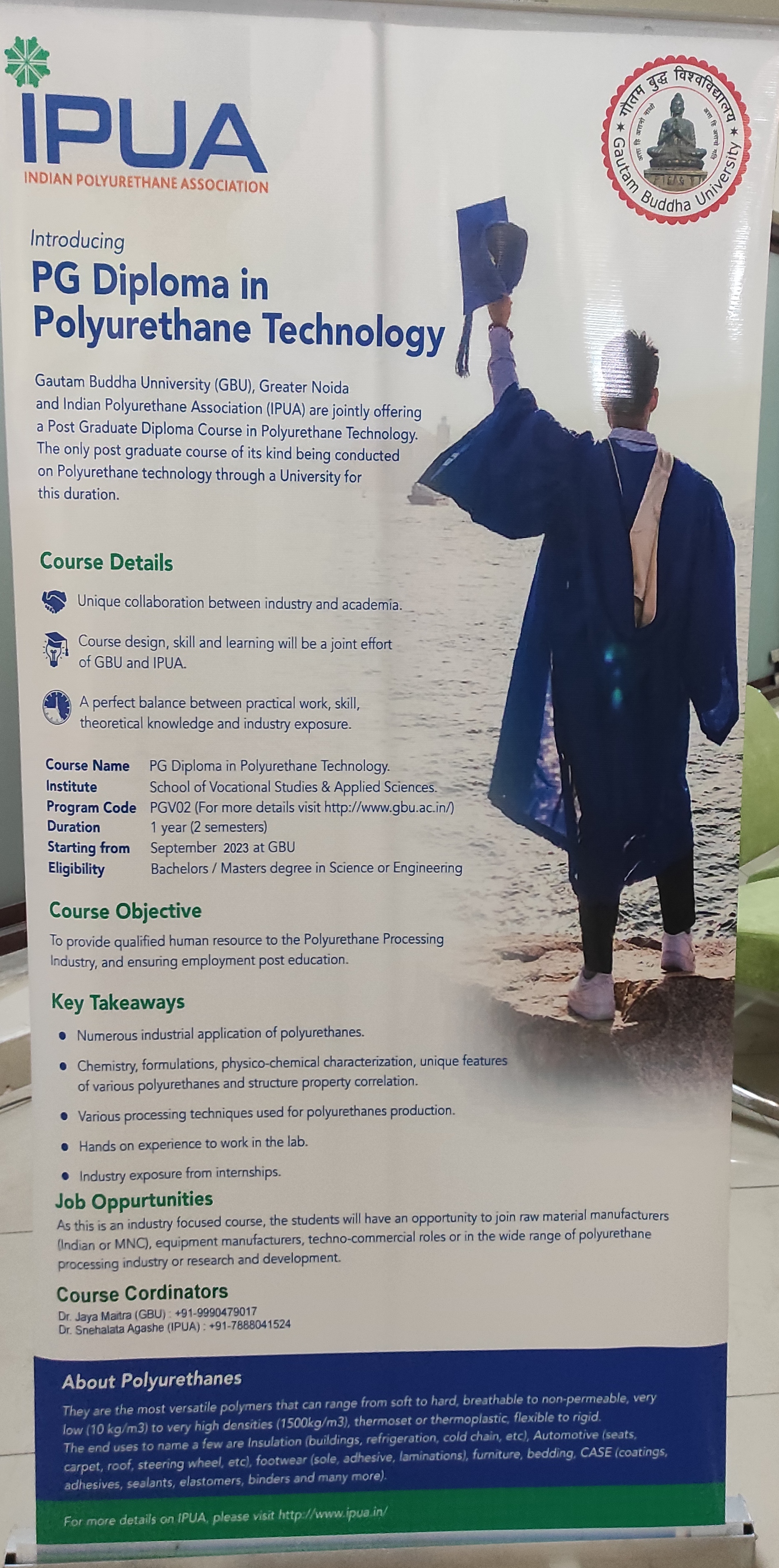
Contact Us
- For Admissions related information contact us at :
Admission Office
Phone No.: 0120-2344234/47
Email : admissions@gbu.ac.in
Placement Helpdesk | SOVSAS
Dr. Vinay Kumar Litoria
Director,Corporate Relations
Phone no.: +91-120-2344209
Mobile no.: +91-9717195787
Email: crc@gbu.ac.in , vinay.litoria@gbu.ac.in
Web: www.gbu.ac.in
Directory | SOVSAS
| Name | Phone No. | Ext. No. |
|---|---|---|
| Dr. Chander Kumar Singh (Dean) | 0120-2344341 | 4341 |
| Dr. Sushil Kumar | 0120-2344350 | 4350 |
| Dr. Vivek Kumar Shukla | 0120-2344348 | 4348 |
| Dr. Jaya Maitra | 0120-2344349 | 4349 |
| Dr. Upma Singh | 0120-2344352 | 4352 |
| Dr. Vandana Singh | 0120-2344351 | 4351 |
| Dr. Pratiksha Saxena | 0120-2344353 | 4353 |
| Dr. Amit K Awasthi | 0120-2344357 | 4357 |
| Dr. Amit Ujlayan | 0120-2344360 | 4360 |
| Dr. Bhawana Joshi | 0120-2344355 | 4355 |
| Dr. Manju Sharma (on special leave) | 0120-2344367 | 4367 |
Faculty | SOVSAS
One of the biggest strengths of the University is its dedicated, competent and accomplished faculty. The faculty members have distinguished academic achievements in their respective areas and the related basic disciplines and are actively involved in teaching, training, and research. They conduct consultancy assignments to keep in touch with the real-life corporate challenges in public and Private Companies, financial institutions, government agencies and international agencies etc. Dedicated academicians and eminent researchers are also committed to bringing out the latent potential in every student. The faculty members of the university are prepared to take an extra step that separates excellence from merely adequate. As this is a residential campus, the faculty members are available for consultations and guidance outside the classroom as well in an informal and customized level.
Research and Publications | SOVSAS
3.4.5 NUMBER OF RESEARCH PAPERS PER TEACHER IN THE JOURNALS NOTIFIED ON UGC WEBSITE DURING THE LAST FIVE YEARS (20)PROF. ANURADHA MISHRAList of Books and Research articles Published/Under publication: • 'Green Materials for Sustainable Water Remediation and Treatment', Anuradha Mishra and James H. Clark (Editors), (2013), (ISBN: 978-1-84973-621-3), RSC Publishing, Royal Society of Chemistry, Cambridge, UK • 'Approach towards Cleaner Environent', Anuradha Mishra and Abha Dubey (Editors), (2013), Durga Publication (ISBN: 81-8428-016-5), India Research Articles: • "Application of dried plant biomass as novel low cost adsorbent for removal of Cadmium from Aqueous solution" Anuradha Mishra, Abha Dubey, Shiwani, IJEST, DOI: 10.1007/s13762-013-0278-0, Springer (2013). • "Tamarind Seed Xyloglucan: A Food Hydrocolloid for Water Remediation" Anuradha Mishra, J. Biobased Mater. Bioenergy 7, 12-18 (2013). • "Greening the Blue: How the World is Addressing the Challenge of Green Remediation of Water" Anuradha Mishra, James Clark in 'Green Materials for Sustainable Water Remediation and Treatment' RSC Publishing, Royal Society of Chemistry, Cambridge, UK (2013). • "Applications of Ionic Liquids in Metal Extraction" Geeta Durga, Deepti Goyal, Anuradha Mishra, in 'Green Materials for Sustainable Water Remediation and Treatment' RSC Publishing, Royal Society of Chemistry, Cambridge, UK (2013). • "Nanomaterials for Water Remediation" Deepti Goyal, Geeta Durga, Anuradha Mishra, in 'Green Materials for Sustainable Water Remediation and Treatment' RSC Publishing, Royal Society of Chemistry, Cambridge, UK (2013). • "Zeolites in Wastewater Treatment" Abha Dubey, Deepti Goyal, Anuradha Mishra, in 'Green Materials for Sustainable Water Remediation and Treatment" RSC Publishing, Royal Society of Chemistry, Cambridge, UK (2013). • "Sustainable Polymer Chemistry: An Introduction to Microwave Heating as a Tool for Polymerization" Anuradha Mishra in 'Approach towards Cleaner Environment' Durga Publication, India (2013). • "Graft Copolymers of Xyloglucan and Methyl methacrylate" Anuradha Mishra, Annu Vij Malhotra, Carbohydrate Polymers, 87(3), 1899-1904 (2012). • "Green Polymer Synthesis: An Overview on Use of Microwave-Irradiation" Anuradha Mishra and Rashmi Dubey, in "Green Chemistry for Environmental Remediation" Rashmi Sanghi & Vandana Singh (Editors), Wiley Scrivener Publishing LLC (2011). • "Biosorption of Chromium (VI) from aqueous solutions using waste plant biomass" Anuradha Mishra, Abha Dubey, Shiwani, (Under Revision), IJEST, D-12-00844, Sringer (2013). • "Adsorption of Chromium ions from aqueous solution on green material beads" Anuradha Mishra, Deepti Goyal, Communicated, ARABJC-D-13-01025 (2013). Conferences / workshops: • Attended a Workshop on Demonstration of Green Chemistry Experiments DGCE-2012 as Resource Person organized by MMH College, Ghaziabad in collaboration with GCNC, Delhi University on Feb 19, 2012. • Delivered an invited lecture in International Conference on Global Trends in Pure & Applied Chemical sciences, organized under the auspices of Asian J Chemistry at Udaipur during March 3-4, 2012. • Chaired Session I in International Workshop on Chemistry for a Sustainable Future, jointly organized by University of Rajasthan and MNIT Jaipur during Dec 10-12, 2012. • Chaired a scientific session in International Conference on Global Trends in Pure & Applied Chemical sciences, organized under the auspices of Asian J Chemistry at Udaipur during March 3-4, 2012. • Chaired Session I in International Workshop on Chemistry for a Sustainable Future, jointly organized by University of Rajasthan and MNIT Jaipur during Dec 10-12, 2012. Patents: • POLYSACCHARIDE AGENTS AND METHODS FOR REMOVING SOLIDS FROM WATER, US Patent Application No. 61/909,864, filed on November 27, 2013 Collaborators: • Prof. James H Clark, Green Chemistry Centre of Excellence, University of York UK. • Department of Chemistry, Texas A & M University, USA. • Department of Phytochemistry, NBRI, India. • Institute of Pesticide Formulation Technology, Ministry of Chemical and Fertilizer, Gurgaon, India. DR. VIVEK KUMAR SHUKLAInternational refereed journals: • Satyendra Kumar, A. K. Biswas, V. K. Shukla, A. Awasthi, R. S. Anand, J. Narain, "Application of Spectroscopic Ellipsometry to probe the environmental and photo-oxidative degradation of PPV", Synthetic Metals 139 (2003) 751. |
Department of Environmental Science | SOVSAS
The Department of Environmental Science came into existence under the School of Vocational Studies and Applied Sciences at the Gautam Buddha University in July 2011. At present, the Department offers four (04) academic programs M.Sc. Environmental Science (15 Seats), Ph.D. in Environmental Science (Full Time and Working Professional), Post Graduate Diploma in Environmental Management (Full time/Working Professional, 10 Seats), and Post Graduate Diploma in Environmental Law and Policy (Full time/Working Professional, 10 Seats).
All the programs follow the Choice-based Credit System (CBCS) comprising of core and elective courses. Students evaluation consists of continuous assessment throughout the semester. The Environmental Science Department boasts a seasoned faculty and modern facilities. Special emphasis is given to teaching, research, and development in thrust areas of Environmental Science.
The forte of the Department lies in a strong team of eight experienced faculty members with diverse specializations ranging from The forte of the Department lies in a strong team of eight experienced faculty members with diverse specializations ranging from Biodiversity Conservation, Environmental Impact Assessment, Social Impact Assessment, Restoration Ecology, Natural Resource Management, Energy and Bioenergy Production, Environmental Microbiology, Bio-deinking of Waste Paper, Lignocellulosic Waste Management, Microbial Bio-remediation, Surface Chemistry, Low-Cost Treatment of Water and Waste Water, Management of Mining Tailing Waste Water etc.
The Department of Environmental Science acts as a nodal centre for teaching the Ability Enhancement Course (AEC), and Environmental Studies (A compulsory course as per the UGC guidelines) at various Departments (s) of the University. Course content is developed in consultation and collaboration with academic and industry experts with the objective to create the high-caliber workforce required to meet contemporary challenges in the area of Environmental Science. The Department's Academic programs are reviewed, revised, and updated on a regular basis, taking into account the needs of academia and industry. click for More details
Department of Physics | SOVSAS
1. Faculty
2. Staff
3. Students (List of Ph.D. Students with RDC approved Thesis Title)
4. Alumni
1. UG Labs: Engineering Physics Lab, Undergraduate Lab I, Undergraduate Lab II, Undergraduate Lab III
1. Research/Broad Area of Research
2. Facilities
3. Projects
4. Publications
1. Admission Booklet 2023-24
2. Announcements
1. C V Raman Club
2. Activities
3. Alumni Meet 2023
4. National Science Day 2023
5. National Science Day 2022